AI search optimization is the work of staying findable when an AI system, rather than a ranked list of blue links, delivers the answer. The shift is already mainstream: Google announced at I/O in May 2026 that AI Mode had passed one billion monthly users within a year of launch, with queries more than doubling every quarter. This guide covers what AI-led discovery changes, what influences whether your content gets cited, and what you can safely ignore.

What AI-Led Discovery Changes
Traditional search rewarded the page that ranked. AI-led discovery rewards the page that gets retrieved and referenced inside a generated answer. Three shifts matter most.
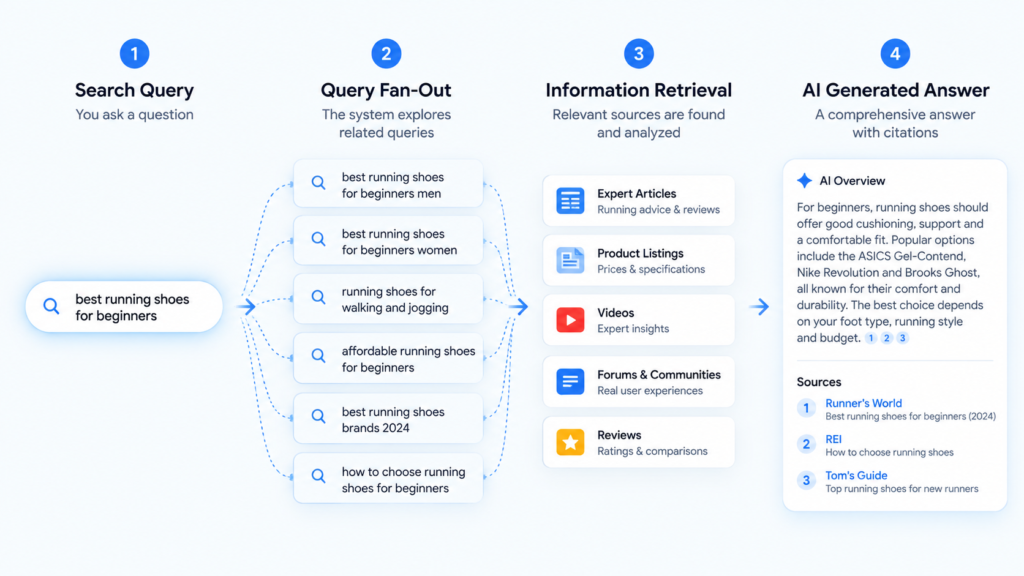
- Answers are assembled, not listed. Google’s generative features use retrieval-augmented generation, also called grounding. They pull relevant pages from the Search index and summarize them with clickable supporting links.
- One question becomes many. Google calls this query fan-out: the model runs concurrent related queries to build a fuller picture. A lawn-weed question can spawn side queries about herbicides, chemical-free removal and prevention.
- Sessions replace single searches. Follow-up questions flow straight from an AI Overview into a conversation, so comparison and shortlisting happen before anyone reaches your site. Fewer clicks, but higher intent.
AI Search Optimization Starts With SEO Fundamentals
Google’s official guidance on generative AI features answers this plainly: SEO best practices still apply, because these features are rooted in the core Search ranking and quality systems. There is no separate AI index to optimize for.
Eligibility comes first. A page must be indexed and eligible to appear in Search with a snippet, and the site must be included in Search generative AI features in Search Console. The rest of the checklist looks familiar:
- Keep important content crawlable and free of accidental indexing blocks
- Reduce duplicate URLs that waste crawl capacity
- Follow JavaScript SEO basics if content renders client-side
- Provide a fast, stable page experience across devices
Publish content that is worth citing
Google states that unique, non-commodity content influences visibility in generative AI search more than anything else in its guide. Its own example contrasts a generic first-time home buyer listicle with a specific account of waiving an inspection and what the sewer line revealed. One restates common knowledge; the other could only be written by someone who was there.
For most brands, that means:
- First-hand reviews, tear downs and test results
- Proprietary data, benchmarks and documented client outcomes
- Named authors with verifiable credentials
- Supporting images and video, since AI responses can surface those too
Commercial details count too: Merchant Center feeds and an accurate Google Business Profile help products and locations appear inside AI responses.
What You Can Ignore
Google’s myth busting section is useful because it removes work. For Google Search, you can set aside:
- llms.text and similar AI text files. Google Search ignores them entirely.
- Chunking content into tiny pages. There is no ideal page length.
- Rewriting copy specifically for AI. These systems already handle synonyms and intent.
- Chasing inauthentic mentions. Quality ranking and spam systems both feed generative features.
- Treating schema as mandatory. Not required for AI features, though still worth using for rich results.
How to Measure AI Search Optimization
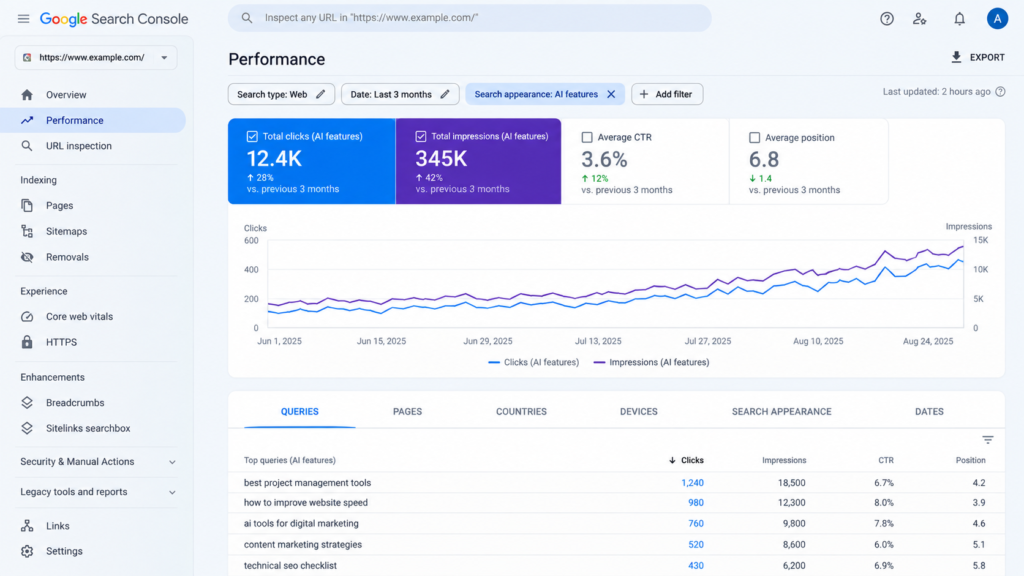
Search Console’s Generative AI performance report shows how content performs inside generative AI features across Search and Discover. Pair it with a few supporting signals:
- Branded search volume, as a proxy for AI-driven awareness
- Conversion rate of assistant referral traffic, which tends to arrive later in the buying process
- Share-of-voice checks: ask the major assistants your category questions and log which brands appear
Preparing for Agentic Discovery
The next layer is agents that act rather than answer. Google is rolling out Search agents that monitor topics in the background, handle local service bookings and, in select US categories, call businesses on a user’s behalf. Browser agents read sites by inspecting rendered screenshots, the DOM and the accessibility tree.
Sensible preparation:
- Make forms, buttons and navigation genuinely accessible
- Keep pricing, availability and contact details accurate and easy to parse
- Track emerging standards such as the Universal Commerce Protocol
Where to Focus Next
AI search optimization is less a new discipline than a sharper test of an old one. Systems that assemble answers still depend on crawlable pages, credible authorship and information they cannot find anywhere else. Brands that publish real expertise and measure visibility with first-party data will keep appearing in AI-led discovery. Those leaning on commodity content will quietly drop out of the answer.
Frequently Asked Questions
Is AI search optimization different from SEO?
From Google’s perspective, no. It treats optimizing for generative AI search as optimizing for the search experience, and therefore as SEO. AEO and GEO describe a focus area, not a separate technical discipline.
Do I need an llms.text file?
Not for Google. Search does not use llms.text or similar AI files, so adding one will not change visibility there. Other services do read them, so maintaining one is harmless.
Why is my traffic falling while rankings look stable?
That pattern usually points to answers being satisfied on the results page rather than a ranking problem. Compare impressions with clicks, then check whether the affected queries are informational questions an AI summary can resolve on its own.
How long does AI search optimization take to show results?
There is no fixed timeline, and Google notes that indexing and serving are never guaranteed. Technical fixes can show up within a crawl cycle; gains from original content usually build over months.
1 Comment